Express Global

  • Subscribe to our RSS feed.
  • Twitter
  • StumbleUpon
  • Reddit
  • Facebook
  • Digg

Friday, 9 August 2013

New review paper finds Medieval Warming Period in China was warmer than modern times

Posted on 10:04 by Unknown
A new review paper by SPPI & CO2 Science:


mwp_china.png


For the Full Report in PDF Form, please click here.


[Illustrations, footnotes and references available in PDF version]


 Excerpts:


The Medieval Warm Period (MWP) was a global climatic anomaly that encompassed a few centuries on either side of AD 1000, when temperatures in many parts of the world were even warmer than they are currently. The degree of warmth and associated changes in precipitation, however, varied from region to region and from time to time; and, therefore, the MWP was manifest differently in different parts of the planet. In this Summary, what occurred in China is reviewed.


Proxy climate records obtained from twenty prior studies to derive a 2000- year temperature history of the northeastern, southern and western sections of the Tibetan Plateau [reveal], in each case, there was more than one prior 50-year period of time when the mean temperature of each region was warmer than it was over the most recent 50-year period.


In the case of the northeastern sector of the Plateau, all of the maximum-warmth intervals occurred during the Medieval Warm Period.


The temperature of the 20th century in eastern China is still within the threshold of the variability of the last 2000 years, which observation clearly indicates that the Chinese data provide no evidence for the hypothesis that the eastern part of the country's 20th-century warming - or even a small part of it - was human-induced. 


The existence of this millennial-scale oscillation of climate, with its prior periods of higher thanurrent temperatures, clearly demonstrates that there is nothing unusual about earth's present climatic state, except that it is surprisingly cool , considering how much more CO2 there is in the air nowadays than there was during the warmer Medieval and Roman Warm Periods.


During the past two millennia, a warming trend in the 20th century was clearly detected, but the warming magnitude was smaller than the maximum level of the Medieval Warm Period.


What is more, they say that  "the modern warm period has lasted [only] 20 years from 1987 to 2006," and that the annual mean temperature series of China since AD 1880 indicates that the country was actually warmer in the mid- 1940s than it was at the time of their study.


Wang et al.'s work demonstrated - for yet another part of the planet - that late 20th-century warmth even with the help of an extra 100 ppm of CO2, was less than that of the MWP, which makes it extremely difficult to believe that earth's current level of warmth largely owes its existence to anthropogenic CO2 emissions, as the world's climate alarmists continue to claim it does.


In concluding this summary, it should be evident from the results of the many studies reviewed herein that for a considerable amount of time during the Medieval Warm Period, most (if not all) parts of China exhibited warmer conditions than those of modern times. And since those earlier high temperatures were obviously caused by something other than elevated atmospheric CO2 concentrations, whatever was responsible for them could easily be responsible for the warmth of today. Indeed, evidence piled upon evidence speaks to the reality of a global millennial-scale oscillation of climate that is totally independent of the air's CO2 concentration. And, therefore, there is every reason to believe that the most recent warming phase of this cycle, which led to the demise of the Little Ice Age and the birth of the Current Warm Period, was totally natural and not the result of the coincidental increase in the air's CO2 content that was produced by the burning of the fossil fuels that drove the engines of the Industrial Revolution.

Read More
Posted in | No comments

New paper predicts solar activity will decline over 21st century to average Holocene levels

Posted on 08:40 by Unknown
A paper published today in Climate of the Past reconstructs solar activity over the Holocene [past 10,000 years] and finds solar activity during the 20th century was at relatively high levels in comparison to the rest of the Holocene, but that "Solar activity is during 28% of the time higher than the modern average (650 MeV), but the absolute values remain weakly constrained due to uncertainties in the normalisation of the solar modulation to instrumental data." The authors predict solar activity will decrease in the 21st century, stating, "Autoregressive modelling suggests a declining trend of solar activity in the 21st century towards average Holocene conditions."


Reconstructed Total Solar Irradiance [TSI] over the Holocene


Future solar activity is predicted to decline to "average Holocene conditions"


Clim. Past, 9, 1879-1909, 2013
www.clim-past.net/9/1879/2013/
doi:10.5194/cp-9-1879-2013


A reconstruction of radiocarbon production and total solar irradiance from the Holocene 14C and CO2 records: implications of data and model uncertainties

R. Roth and F. Joos
Climate and Environmental Physics, Physics Institute, University of Bern, Bern, Switzerland
Oeschger Centre for Climate Change Research, University of Bern, Bern, Switzerland

Abstract. Radiocarbon production, solar activity, total solar irradiance (TSI) and solar-induced climate change are reconstructed for the Holocene (10 to 0 kyr BP), and TSI is predicted for the next centuries. The IntCal09/SHCal04 radiocarbon and ice core CO2 records, reconstructions of the geomagnetic dipole, and instrumental data of solar activity are applied in the Bern3D-LPJ, a fully featured Earth system model of intermediate complexity including a 3-D dynamic ocean, ocean sediments, and a dynamic vegetation model, and in formulations linking radiocarbon production, the solar modulation potential, and TSI. Uncertainties are assessed using Monte Carlo simulations and bounding scenarios. Transient climate simulations span the past 21 thousand years, thereby considering the time lags and uncertainties associated with the last glacial termination.

Our carbon-cycle-based modern estimate of radiocarbon production of 1.7 atoms cm−2 s−1 is lower than previously reported for the cosmogenic nuclide production model by Masarik and Beer (2009) and is more in-line with Kovaltsov et al. (2012). In contrast to earlier studies, periods of high solar activity were quite common not only in recent millennia, but throughout the Holocene. Notable deviations compared to earlier reconstructions are also found on decadal to centennial timescales. We show that earlier Holocene reconstructions, not accounting for the interhemispheric gradients in radiocarbon, are biased low. Solar activity is during 28% of the time higher than the modern average (650 MeV), but the absolute values remain weakly constrained due to uncertainties in the normalisation of the solar modulation to instrumental data. A recently published solar activity–TSI relationship yields small changes in Holocene TSI of the order of 1 W m−2 with a Maunder Minimum irradiance reduction of 0.85 ± 0.16 W m−2. Related solar-induced variations in global mean surface air temperature are simulated to be within 0.1 K. Autoregressive modelling suggests a declining trend of solar activity in the 21st century towards average Holocene conditions.

Read More
Posted in | No comments

New paper finds the Sun controls the hydrological cycle of southern South America

Posted on 08:03 by Unknown

A paper published today in the International Journal of Climatology finds robust evidence that solar activity controlled the hydrological cycle in southern South America from the early 1900s to 2011. The authors find high river discharges lag solar maxima by about 2 years, and low discharges lag solar minima by about 2 years. According to the paper, "Previous studies have shown a close relationship between the subtropical Argentinean Andean Rivers and the El Niño/Southern Oscillation (ENSO), as well as a solar influence on the ENSO variability. We suggest that El Niño events occurring a few years after solar maxima could explain the connection."

The IPCC claims tiny variations in solar activity over solar cycles cannot affect climate, but this study and many other peer-reviewed publications demonstrate multiple solar amplification mechanisms by which tiny variations in solar activity can have large amplified effects on climate, via ocean oscillations such as ENSO, atmospheric oscillations such as the Madden-Julian Oscillation, Quasi-biennial Oscillation, Aleutian Low, Eurasian pattern, & Asian monsoon, and via stratospheric ozone, and sunshine hours/clouds.

Are southern South American Rivers linked to the solar variability?

Rosa Hilda Compagnucci 1, Ana Laura Berman 2, Victor Velasco Herrera 3, Gabriel Silvestri 2

This article explores the Sun's influence on the hydrological cycle in southern South America (SSA) at the range of interannual-to-multidecadal scales from the early 1900s to 2011. The solar variability is described by the sunspot number (SSN) index. The hydrological cycle is examined by using annual mean discharges of the Paraná River (PAR) and the Atuel River (ATU) that represents the behaviour of the subtropical Argentinean Andean hydrological system. Wavelet-based methods are used in order to describe relationships in the entire time-frequency domain. The SSN–PAR connection is statistically weak in oscillations with period about 11 years (the Schwabe's solar cycle). Therefore, the solar forcing at this scale must be considered with great caution. The periodicity about 30 years is highly significant throughout the analysed period. Two potential physical mechanisms affecting the Paraná discharge could be involved: one is the solar irradiance influence on the Inter Tropical Convergence Zone (ITCZ), and the other is the solar influence on the Pacific long-term variability. The SSN–ATU connection shows by far the most striking, robust and convincing result for the Schwabe cycle. A large amplitude and statistically significant cycle with a period about 11 years is observed not only in the Morlet-based global and local wavelet spectra of the Atuel discharges and SSN but also in the global and local spectra of Cross and Coherent wavelets in most of the analysed period. High (low) discharges occur following maxima (minima) of the Schwabe cycles with time lags of up to ∼2 years. Previous studies have shown a close relationship between the subtropical Argentinean Andean Rivers and the El Niño/Southern Oscillation (ENSO), as well as a solar influence on the ENSO variability. We suggest that El Niño events occurring a few years after solar maxima could explain the connection. Periodicities longer than 30 years are suggested.

Read More
Posted in | No comments

Thursday, 8 August 2013

New paper finds temperature record in China contaminated by urban heat island effect

Posted on 19:06 by Unknown
A paper published today in the Journal of Climate finds the temperature record in China was significantly influenced by the growth of urban areas around weather stations originally located in rural areas [the urban heat island effect], rather than actual planetary warming. According to the authors, "nearly half of the stations in the study area have been converted from non-urban to urban stations as a result of land cover change associated with urban expansion. We determined that both land cover change and human activity play important roles in temperature change and contribute to the observed warming, particularly in urbanized stations, where the highest amount of warming was detected. Urbanized stations showed higher...temperature trends than those of unchanged stations." The paper corroborates prior work demonstrating that half of the global warming in the US is artificial due to increased urbanization & siting issues.


The paper reminds me of the email from Phil Jones to James Hansen found in the NASA FOIA files in which Jones complains about the Chinese trying to obtain an accurate temperature record by moving their thermometers away from urban heat islands; Jones laments that the Chinese don't obtain temperature measurements from airports maximally contaminated by the urban heat island effect!


Journal of Climate 2013 ; e-View


doi: http://dx.doi.org/10.1175/JCLI-D-12-00698.1


Urbanization impact on temperature change in China with emphasis on land cover change and human activity


Yan Li,a,b Lijuan Zhu,c Xinyi Zhao,a,b Shuangcheng Li,a,b and Yan Yand


a Key Laboratory for Earth Surface Processes, Ministry of Education, Peking University, Beijing, 100871, China


b College of Urban and Environmental Sciences, Peking University, Beijing, 100871, China


c State Key Laboratory of Satellite Ocean Environment Dynamics/Second Institute of Oceanography, State Oceanic Administration, Hangzhou, 310012, China


d Air Force Meteorological Center, Beijing, 100843, China


Abstract


The impact of urbanization on temperature trends in China was investigated with emphasis on two aspects of urbanization, land cover change and human activity. A new station classification scheme was developed to incorporate these two aspects by utilizing land cover and energy consumption data. Observation temperature data of 274 stations and National Centers for Environmental Prediction/National Center for Atmospheric Research (NCEP/NCAR) reanalysis temperature from 1979 to 2010 were used in conducting the observation minus reanalysis (OMR) method to detect urban influence. Results indicated that nearly half of the stations in the study area have been converted from non-urban to urban stations as a result of land cover change associated with urban expansion. We determined that both land cover change and human activity play important roles in temperature change and contribute to the observed warming, particularly in urbanized stations, where the highest amount of warming was detected. Urbanized stations showed higher OMR temperature trends than those of unchanged stations. In addition, a statistically significant positive relationship was detected between human activity and temperature trends, which suggests that the observed warming is closely related to the intensity and spatial extent of human activity. In fact, the urbanization effect is strongly affected by specific characteristics of urbanization in local and regional scales such as land cover change, human activity, and other related factors.


Read More
Posted in | No comments

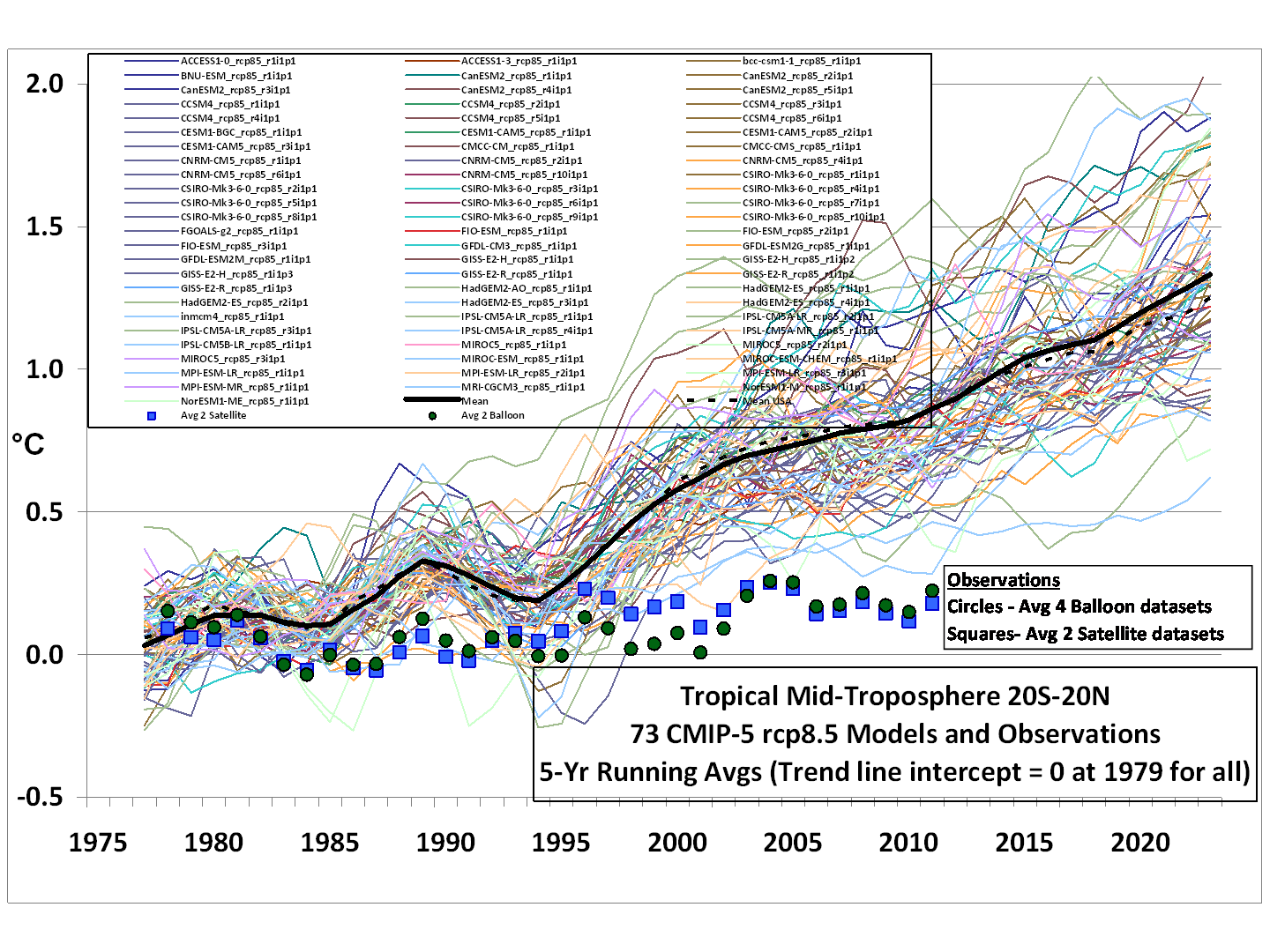
New paper finds little improvement of IPCC climate models over past 4 years

Posted on 12:50 by Unknown
Every single one of the 73 latest IPCC climate models are overly-sensitive to CO2:


From the latest edition of the NIPCC Report:


Meet the new models: Are they any better than the old models?


In a paper published in Nature Climate Change, Knutti and Sedlacek (2013) write that "estimates of impacts from anthropogenic climate change rely on projections from climate models," but they say that "uncertainties in those have often been a limiting factor, particularly on local scales." However, as they continue, "a new generation of more complex models running scenarios for the upcoming Intergovernmental Panel on Climate Change Fifth Assessment Report (IPCC AR5) is widely, and perhaps naively, expected to provide more detailed and more certain projections." But are these expectations really being met?

Exploring the subject for themselves, the two researchers performed what they described as "a first comparison between projections from CMIP3 and CMIP5," in order to see to what extent real progress in the modeling of Earth's global climate may have been being made. And what did they find?

In the words of Knutti and Sedlacek:


(1) "Projected global temperature change from the new models is remarkably similar to that from those used in IPCC AR4 after accounting for the different underlying scenarios."
(2) "The local model spread has not changed much despite substantial model development and a massive increase in computational capacity
."

(3) "There is ... little evidence from CMIP5 that our ability to constrain the large-scale climate feedbacks has improved significantly."

(4) "Model mean patterns of temperature and precipitation change ... are remarkably similar in CMIP3 and CMIP5."

(5) "Robustness over land is slightly higher but also similar in CMIP3 and CMIP5," which fact they describe as "troublesome."


In light of these findings, therefore, and "if the past is a guide to the future," as the two researchers put it, "then uncertainties in climate change are unlikely to decrease quickly, and may even grow temporarily." And they further state that they "have illustrated this for seasonal temperature and precipitation," while adding that "it is likely that impact-relevant predictions, for example of extreme weather events, may be even harder to improve."


So ... meet the new models, which are nearly the same as the old models -- struggling in their ability to accurately simulate the Earth's climate.


Reference: Knutti, R. and Sedlacek, J. 2013. Robustness and uncertainties in the new CMIP5 climate model projections. Nature Climate Change 3: 369-373.


Read More
Posted in | No comments

New paper finds another non-hockey-stick in Chile

Posted on 12:43 by Unknown
A new paper published in Palaeogeography, Palaeoclimatology, Palaeoecology reconstructs temperatures in Southern Chile over the past 1,600 years and finds another non-hockey-stick, with the Medieval Warm Period up to 2.9°C warmer than the most recent Current Warm Period temperatures.


From the latest edition of the NIPCC Report:


The Medieval Warm Period in Northern Chile


In the words of Elbert et al. (2013), "climate and environmental reconstructions from natural archives are important for the interpretation of current climatic change," but they note in this regard that "few quantitative high-resolution reconstructions exist for South America, which is the only land mass extending from the tropics to the southern high latitudes."


In a study designed to partially fill this data void, Elbert et al. analyzed sediment cores from two adjacent lakes in Northern Chilean Patagonia - Lago Castor (45°36'S, 71°47'W) and Laguna Escondida (45°31'S, 71°49'W) - for total organic carbon and total nitrogen concentrations, as well as biogenic silica (bSi) flux, which they "compared with meteorological data from the CRU TS 3.0 reanalysis data set (Mitchell and Jones, 2005; 0.5°x0.5° grid cell 45°S/72°W)," while further noting that "radiometric dating (210Pb, 137Cs, 14C-MS) suggests that the cores reach back to c. 900 BC (Laguna Escondida) and c. 1900 BC (Lago Castor)."


The team of ten scientists (nine Swiss and one Chilean) report that the temperature record they developed "compares well with the multi-decadal temperature variability documented in the few paleo-temperature archives available in southern South America." And that record shows, as may be seen in the figure below, that the peak warmth of the Medieval Warm Period was about 2.9°C greater than the most recent of sediment-derived Current Warm Period temperatures.


Figure 1. Reconstructed annual temperature anomalies, with respect to the 20th-century mean, which also just happens to occur shortly after the beginning of the 20th century and at its end, as derived for Laguna Escondida. Adapted from Elbert et al. (2013).


Once again, and for a region of the Earth far removed from the North Atlantic Ocean and the lands that surround it, we have evidence for the existence of the Medieval Warm Period and its significant exceedance of the warmth of the Current Warm Period, clearly suggesting that there is nothing unusual, unnatural or unprecedented about Earth's current level of warmth, nor is there any compelling reason to attribute the essentially non-existent 20th-century warming at Laguna Escondida to the concomitant increase in the atmosphere's CO2 concentration, for there was little to no increase in the air's CO2 content during the development of the much greater peak warmth (~2.9 °C) that was experienced at that location back in the middle of the MWP.


Reference: Elbert, J., Wartenburger, R., von Gunten, L., Urrutia, R., Fischer, D, Fujak, M., Hamann, Y., Greber, N.D. and Grosjean, M. 2013. Late Holocene air temperature variability reconstructed from the sediments of Laguna Escondida, Patagonia, Chile (45°30'S). Palaeogeography, Palaeoclimatology, Palaeoecology 369: 482-492.


Additional Reference: Mitchell, T.D. and Jones, P.D. 2005. An improved method of constructing a database of monthly climate observations and associated high-resolution grids. International Journal of Climatology 25: 693-712.


Prior posts on non-hockey-sticks

Read More
Posted in | No comments

More green insanity: Burning US trees in UK power plants

Posted on 12:21 by Unknown


SCIENCE & ENVIRONMENT
Renewable energy: Burning US trees in UK power stations


By Roger Harrabin  Environment analyst, Georgia, US

Swamp forests in the US are being felled to help keep the lights on in the UK. Is this really the best way to combat climate change?

Environmentalists are trying to block the expansion of a transatlantic trade bringing American wood to burn in European power stations.

The trade is driven by EU rules promoting renewable energy to combat climate change.

Many millions of tonnes of wood pellets will soon be shipped annually to help keep the lights on in the UK. Other EU nations may follow.

Critics say subsidising wood burning wastes money, does nothing to tackle climate change in the short term, and is wrecking some of the finest forests in the US.

I have tracked the controversial trade from the swamp forests of North Carolina to the towering chimneys of the UK's biggest power station, Drax in Yorkshire, which is converting half its boilers from coal to wood.

The implications are complicated and disputed, but it is clear that EU leaders did not have burning American wood in mind when they mandated that 20% of Europe's energy should come from "renewable" sources.

Environmentalists are preoccupied with the potential effects of the trade on climate change and wildlife.

So I travelled with Drax representatives to a timber operation in southern Georgia run by their main supplier, the timber firm Plum Creek.

It is the biggest private landowner in the US. Its operations are impressive, from the large-scale nurseries selectively breeding seedlings for vigour and disease-resistance, through to immensely productive plantations.

This is among the most effective tree farming in the world. Competition from weeds is eliminated in dark monocrop tree stands where wildlife is scanty.

The plantations are thinned and harvested by mechanical giants which cut and throw whole trees as if they were twigs.

The trees are planted close to each other to encourage tall straight specimens to reach for the light. These will have most value for planks. As the plantation grows, some trees are removed to make space.

The thinned-out trees are of low value. They are traditionally sold to the pulp and paper industry but now there's a new market - power stations in the UK.

The industry contends there is plenty of low-grade material to source pulp and power, but some studies suggest that this may be wishful thinking.

Critics fear that increasing demand from power generators will encourage foresters to take land that is currently growing food.

Their other fear is that plantation forests will replace even more of the natural forests of the southern US, which are already dwindling fast.

I drove with environmentalists at dawn to a gorgeous swamp forest in North Carolina. The birdsong was entrancing, and a scarce prothonatory warbler - known as the swamp canary - danced before our TV lens.

The wood fuel industry has not advertised that it also takes trees from natural forests like this to boil kettles in Britain - but that's what happens. Most of the swamp forests in south-east US are in the hands of small private landowners and they face few restrictions on what they do with their assets.

It is said that local landowners cut their forest twice; once when their daughter gets married and once when they retire. Cutting typically means clear-cutting, and that leaves some left-over, low-value trees for pulp or power.

So is the environmentalist argument really against the power industry? Or against America's laws on forest biodiversity?

It depends, of course, on how much the power industry expands. But the best way of protecting the forests may be for benefactors to buy them, because those wedding dresses will still need to be paid for.

The other big environmental issue is climate change. When the EU set its 2020 target of sourcing 20% of energy from renewables, some leaders thought the deal referred to electricity. (I know because I spoke to Downing Street on the day of the decision).

In fact, it included energy for transport and heating too, so the bar was set much higher than anticipated. Policies create opportunities and entrepreneurs were quick to exploit the potential of wood power, which will soon create more renewable energy in the UK than wind and solar combined.

But will this achieve the stated goal of cutting carbon emissions?

The British government will shortly announce its rules for the sustainability of "biomass" burning for power. It will set a standard for emissions created from the cutting, drying and shipping and timber but it will make a working assumption that burning the wood has nil CO2 emissions as new trees will suck up the CO2 emitted by wood burning.

Critics say this is simplistic as it fails to recognise that it will take maybe 50 years for new trees to absorb the CO2, whilst politicians agree that emissions need to be cut immediately to prevent carbon over-heating the planet.

It also fails to account for the fact that in the US the forest stock has been increasing and this process offsets the growth in carbon emissions from homes and industry. Burning American trees in the UK reduces America's "carbon sink".

Foresters argue that this doesn't matter much as long as the total biomass sent for export is no greater than the wood used in a single large pulp mill. But these numbers will grow fast.

Liberal Democrat MP Nick Harvey has tabled an amendment to the UK Energy Bill insisting that long-term subsidies for biomass burning should only be agreed for plants that capture and store CO2 emissions, or use the waste heat for other purposes. (Drax alone expects subsidies of more than £1bn in coming years from people's electricity bills.)

But the amendment is not supported by any of the major parties.

It looks as though UK Government policy is being driven by the need to hit mandatory targets and keep electrons flowing, rather than by a deep desire to cut CO2 emissions right now.

Follow Roger on Twitter @rharrabin

Read More
Posted in | No comments
Newer Posts Older Posts Home
Subscribe to: Posts (Atom)

Popular Posts

  • The green dream is not compatible with billions of the poor in search of higher living standards
    A Common Fallacy in the Energy and Climate Debate By [warmist] Schalk Cloete, The Energy Collective, 9/10/13 The vast majority of the energy...
  • UK Climate Commission submission: IPCC AR5 Report 'definitely weakens the case for action' on climate
    A submission to the UK Energy and Climate Change Committee inquiry into the IPCC AR5 Report points out how the IPCC has deliberately obscure...
  • Gavin's worry about the state of understanding of climate science comes true
    From a comment at WUWT: DB   says: December 28, 2013 at 5:34 pm Jimbo wrote: “Wasn’t Gavin for a specified period of no global surface warmi...
  • Special Report: The Age of Plenty debunks alarmist claims of food shortages
    Paging Paul Ehrlich :  IEEE Spectrum , the journal of the world's largest professional association for the advancement of technology, ha...
  • Paper: Scientists on ice are media's nightmare
    EDITORIAL: Scientists on ice are media's nightmare The Gazette editorial •  Updated: January 4, 2014 at 8:28 am  • Published: January 4,...
  • California Energy Commission says no to desert solar plant that could kill birds
    Finally, a bit of environmental sanity from California: California Energy Commission says no to desert solar plant that could kill birds Do ...
  • New paper finds glaciers have been melting naturally at the same rate since 1850, no acceleration predicted
    A paper published today in The Cryosphere finds global glaciers melted at the same rate in the first half of the 20th century as in the sec...
  • Ship of fools finally rescued by irony
    Carbon to the Rescue Fossil fuels power retrieval of trapped climate scientists. WSJ.COM 1/2/13: Reporting on the environmental movement has...
  • Cold fact: More record lows than highs in the USA in 2013
    Cold fact: More record lows than highs in the USA in 2013 By Doyle Rice, @USATODAYWeather, USA TODAY Posted 1/2/2014 12:00:03 AM Miley Cyrus...
  • Executive Summary of the NIPCC Climate Change Reconsidered II Report
    Executive Summary from the NIPCC Climate Change Reconsidered II Report, released 9/16/13: Executive Summary  This report is produced by the ...

Blog Archive

  • ▼  2014 (20)
    • ▼  January (20)
      • Record cold from global warming causing 'polar vor...
      • New paper finds glaciers have been melting natural...
      • Paper finds solar amplification mechanism via clou...
      • Game Over! IPCC Quietly Concedes Defeat
      • Gavin's worry about the state of understanding of ...
      • Renowned physicist Freeman Dyson: Global warming i...
      • UK Climate Commission submission: IPCC AR5 Report ...
      • Paper: Scientists on ice are media's nightmare
      • Bravo! Global carbon markets' value dropped 38% in...
      • Global warming believers are today's climate deniers
      • Fossil Fuels to the Rescue in Antarctica
      • Antarctic ice shelf melt 'lowest ever recorded, gl...
      • The Alps defy global warming - but no one wants to...
      • WSJ: 'We long for the days when the weather wasn't...
      • New research shows Greenland is melting naturally ...
      • 5 million Scottish trees felled for wind farms, no...
      • California Energy Commission says no to desert sol...
      • Cold fact: More record lows than highs in the USA ...
      • 71 new papers reported in 2013 demonstrating the S...
      • Ship of fools finally rescued by irony
  • ►  2013 (480)
    • ►  December (77)
    • ►  November (64)
    • ►  October (65)
    • ►  September (130)
    • ►  August (108)
    • ►  July (36)
Powered by Blogger.

About Me

Unknown
View my complete profile